

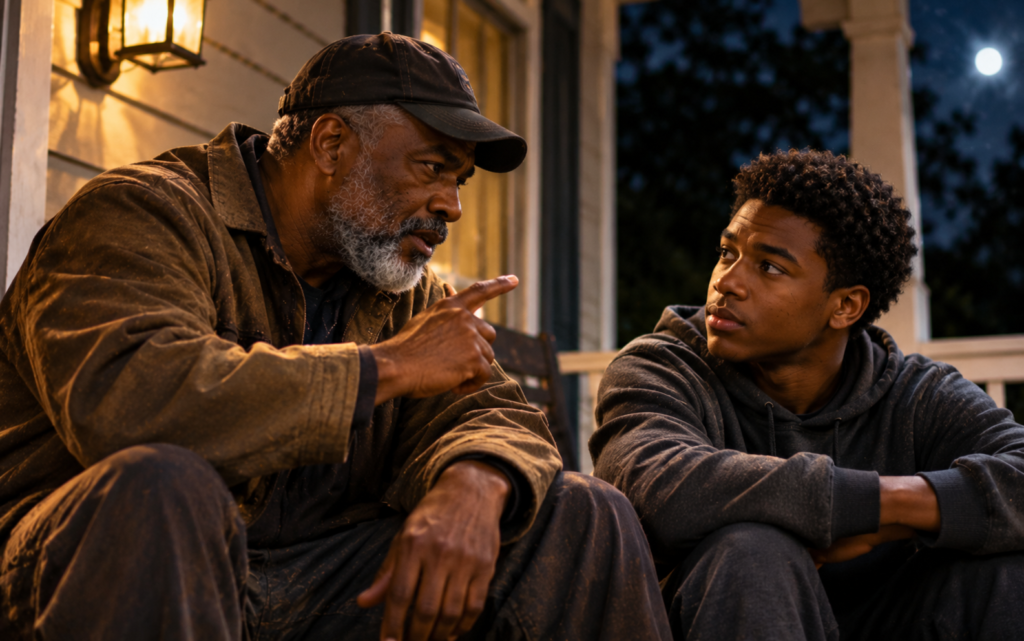
“No Excuses”: The Words My Father Gave Me on a Porch at 0200
Meta description: On February 22, 1988, a Louisiana mechanic handed his son a two-sentence map for life. Here is what “no excuses” really means, and what it cost to learn it.
At 0200 in Marion, Louisiana, the pine woods don’t sleep. They hum. On February 22, 1988, that sound was the last thing I heard as a boy and the first thing I carried as a man.
I was standing on the porch of the house my father built, holding a small bag. The air was heavy with damp earth and a little woodsmoke. My daddy stood beside me, a mechanic and logger who spoke through the turn of a wrench. He didn’t make a speech. He gave me a map in two sentences.
“No excuses,” he said. “Don’t let nobody stop you from getting what you want out of life.”
The road to that porch
The Navy had been pulling at me since 1986, when I raised my right hand and joined the Delayed Entry Program. It felt like a door out of the smallness I could sense closing in around me. Then, before I ever saw boot camp, I almost lost it all.
I was horseback riding with a high school friend when someone rang the bell to call the animals in to eat. The horse beneath me changed in a heartbeat. I lost control, got thrown, and my right leg caught in the saddle while the horse kept going. The result was a compound fracture of my right leg, a broken left leg, and a broken left hand.
The doctors talked about amputating. They talked about pins, screws, and whether I would ever walk straight again. I was a young man trying to get into the Navy, and those words felt heavier than any cast. I didn’t pray with fancy words. I prayed the way pain prays: Lord, if You brought me this far, don’t leave me here.
Nine months of casting, rehab, and uncertainty followed, and full recovery took two years. By the grace of God, I healed with no amputation, no pins, and no screws. That accident taught me something before the Navy ever did: my life was not only in my hands.
What “no excuses” really means
People hear “no excuses” and think it means pretending hard things aren’t hard. My father never meant that. A man who logged timber and fixed engines for a living knew exactly how hard conditions could be.
Later, on deployments where heat, dust, and broken equipment tested everyone’s patience, I came to understand it plainly: no excuses doesn’t mean you pretend conditions aren’t hard. It means you accept the conditions and still deliver what is required of you.
An excuse protects your pride. A report protects the mission. The difference is simple: what happened, what you did about it, and what you need next. That habit started on a porch in Marion and followed me through every engine room, inspection, and business meeting that came after.
The last report
When I was still young in the Navy, a Red Cross message told me my father was critically ill. I went home and found the strong mechanic who used to speak through a wrench looking worn, like a good tool used hard for a long time.
I leaned in close and said, “Dad, I’m doing it. I’m in the Navy. I’m where I’m supposed to be.” Then I added the two words I knew mattered most to him: “No excuses.”
He didn’t give a long speech. He looked at me with the same steady eyes I remembered from the porch, and everything he ever tried to teach me was in that look: keep moving, keep working, take care of your people, and don’t you dare quit on yourself.
Decades later, after thirty-two years in uniform, I stood at his grave and gave him one more report. “Dad, I kept going. I kept the faith. And I didn’t let excuses define me.”
Three ways to put it to work
- Separate explanation from excuse.Say what happened and what you will do about it.
- Do the work before you ask for the reward.Preparation is quiet, and it counts.
- Don’t wait for perfect conditions.Accept the conditions you have and deliver anyway.
This is where my story begins, and it is one of the threads that runs through every chapter of Beyond the Trees. If you have ever stood at the edge of a decision with a small bag in your hand, I wrote this book for you.